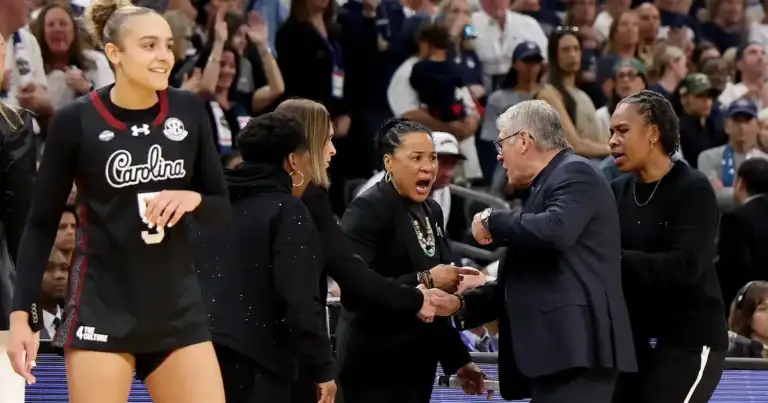

The air in the press conference room was thick with unspoken words, a silence more deafening than any roar from the stands. On April 3rd, 2026, after his UConn Huskies fell 82-68 to Dawn Staley’s indomitable South Carolina Gamecocks, Geno Auriemma delivered a masterclass in passive aggression, a post-game snub that felt less like a strategic move and more like a gut punch to the very spirit of sportsmanship. This wasn’t just a loss; it was a public display of a legend struggling to reconcile with a shifting paradigm, and frankly, it was a bad look.
The Silent Treatment Heard ‘Round the World
Auriemma, a titan of women’s college basketball, chose to focus almost exclusively on his team’s shortcomings, offering only the most perfunctory, almost dismissive, acknowledgment of Staley or her squad. It was a performance that spoke volumes, fueling speculation about a deep-seated tension between these two coaching giants. Staley, on the other hand, handled the post-game with her characteristic poise, praising her team’s grit and even extending a respectful nod to the rivalry itself. Her grace in victory only amplified Auriemma’s apparent pique.
The Gamecocks’ dominance wasn’t just a win; it was a statement. They didn’t just beat UConn; they outplayed them, out-hustled them, and frankly, out-classed them. This wasn’t a fluke; it was a program built on relentless effort and a clear vision. The final score, South Carolina 82 – UConn 68, tells only part of the story. The true narrative was etched in every possession, every rebound, every strategic timeout.
- Kamilla Cardoso was an absolute force of nature, dominating the paint with 22 points, a staggering 13 rebounds, and 3 blocks.
- Raven Johnson, the orchestrator of South Carolina’s offense, added 15 points and dished out 7 assists, running the floor with an intelligence and flair that often goes unheralded.
- And let’s not forget Te-Hina Paopao, who lit up the scoreboard with 18 points, including a crucial 4 three-pointers, stretching UConn’s defense to its breaking point.
UConn’s star, Paige Bueckers, poured in 25 points, showcasing her undeniable talent, but even her brilliance couldn’t stem the tide against South Carolina’s cohesive, relentless team effort. This wasn’t a game of individual heroics; it was a triumph of collective will.
Auriemma’s Struggle and the Shifting Power Dynamics
This wasn’t merely a tough loss for UConn; it was a seismic event, a clear demarcation point in the landscape of women’s college basketball. For decades, Geno Auriemma’s Huskies were the undisputed queens, a dynasty built on an almost mythical aura of invincibility. They didn’t just win championships; they redefined what was possible in the sport.
But the tides, as they always do, have turned. Dawn Staley has not just built a team; she has forged a new dynasty at South Carolina. Her program is a juggernaut – powerful, deep, and radiating an unshakeable confidence that has translated into consistent championship contention. This victory wasn’t just another notch on their belt; it was a definitive declaration of their reign at the summit.
Even the usually measured Stephen A. Smith didn’t mince words, branding Auriemma’s post-game conduct as “classless” and “B.S.” He rightly pointed out that Auriemma was out-coached and should have had the grace to acknowledge it. Smith hit the nail on the head; Auriemma’s silence reeked of a sore loser, a legendary coach unable or unwilling to extend the basic courtesy of acknowledging a superior performance from a rival.
“She’s got a good team. They played well tonight.”
That was Auriemma’s terse, almost robotic, response when pressed about Staley. His tone was flat, devoid of any genuine admiration or respect. He then pivoted, almost defensively, stating, “I’m focused on my team. We didn’t play well enough to win. That’s it.” It felt like a deliberate, calculated minimization of Staley’s achievement, a transparent attempt to diminish the magnitude of her team’s victory. Was he trying to suggest that South Carolina’s win was merely a byproduct of UConn’s failure, rather than a result of their own excellence? It certainly came off that way.
Staley, in stark contrast, was a picture of magnanimity. “I’m incredibly proud of our team’s effort tonight,” she beamed, acknowledging the intense rivalry while still managing to elevate her opponent. “Geno is a legendary coach,” she offered, a respectful nod that highlighted her own confidence and class. That, my friends, is how a true leader handles a monumental win.
Beyond the Court: Leadership Under Pressure
Coaching at this level is an unforgiving profession. These individuals operate under an almost unbearable weight of expectation, every decision scrutinized, every word dissected. Could Auriemma’s post-game reticence be a coping mechanism, a shield against the sting of defeat? Perhaps. The human element in such high-stakes environments is undeniable.
However, even under the most intense pressure, there exists an unspoken code of conduct, especially for a figure of Auriemma’s stature. His reaction, or lack thereof, wasn’t just about basketball; it was a profound statement about leadership. It betrayed a deep-seated frustration, a palpable reluctance to concede that someone else might, in that moment, simply be better. This isn’t just about X’s and O’s; it’s a lesson in character. When faced with adversity, do you elevate your opponent, showcasing humility and respect, or do you retreat into a shell of dismissiveness?
The Echoes of Silence: Recruiting and Legacy
This loss reverberates far beyond the scoreboard. It casts a shadow over UConn’s program and, at least in the immediate aftermath, chips away at Auriemma’s storied legacy. South Carolina’s ascendance isn’t just about winning games; it’s about becoming a magnet for the nation’s top talent. Young, aspiring athletes watch these interactions. They see how coaches handle both victory and defeat. They witness the grace, or lack thereof, displayed by those at the pinnacle of the sport.
UConn’s recruiting efforts could face an uphill battle, particularly if Auriemma appears unwilling to acknowledge the seismic shift in power. The best players want to play for winners, yes, but they also want to play for leaders who embody sportsmanship and respect. Right now, the coach who unequivocally commands that respect, who sets the tone for the future of the sport, is Dawn Staley. This isn’t just about who wins the next game; it’s about who inspires the next generation.
A Changing of the Guard, Undeniable and Irreversible
This feels less like a temporary blip and more like an undeniable changing of the guard. UConn had its glorious, unprecedented run, a dynasty that will forever be etched in the annals of sports history. But now, it is unequivocally South Carolina’s era. Auriemma’s post-game silence, in its profound way, only served to underscore this reality. He may not be ready to admit it, but the evidence was laid bare on the court for all to see.
Will Auriemma ever truly acknowledge Staley’s unparalleled success with the warmth and respect it deserves? Or will his stubborn silence continue to define their rivalry? This much is certain: the competition between these two titans is far from over. But for now, Staley holds all the cards, and she is playing them with an admirable blend of skill, passion, and, crucially, grace. This moment transcends mere basketball; it’s a poignant narrative about resilience, ambition, and the harsh, often humbling, realities of competition. It’s about accepting defeat with dignity, a test that, on that particular night, Auriemma failed.
Photo: Christian Petersen / Getty Images / Getty Images North America
Source: Google News