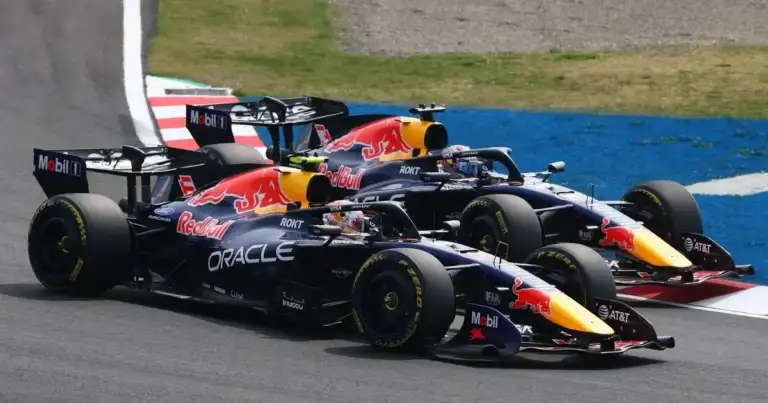

Imagine being the undisputed champion, standing atop the world, only to discover a ticking time bomb beneath your feet. For Red Bull Racing, that bomb is the 2026 Formula 1 engine regulations. According to their own top brass, they’re currently a staggering “one second off” the pace. This isn’t just a bump in the road; it’s a potential full-blown catastrophe for the reigning constructors’ and drivers’ champions.
Red Bull’s Looming Nightmare: A Full Second Off
Christian Horner and Helmut Marko, usually masters of strategic understatement, are finally letting slip the grim truth. Their much-hyped Red Bull Powertrains (RBPT) engine, the cornerstone of their independent future, is nowhere near ready for 2026. Simulations paint a chilling picture: they are a shocking “one second off” their rivals. In the razor-thin margins of Formula 1, that’s not merely a gap; it’s a chasm so wide you could lose a whole season in it.
A single second per lap is an eternity in F1. This translates to starting races from the back of the grid, watching Mercedes and Ferrari disappear into the distance, and potentially, a complete unraveling of their hard-won dominance. This isn’t some minor setback you can engineer your way out of with a few clever aero tweaks.
The Hubris Behind the Engine Project
Red Bull’s current reign, fueled by Max Verstappen’s unparalleled talent and Adrian Newey’s aerodynamic genius, has masked a perilous gamble. After Honda’s departure, the decision to build their own power unit was hailed as audacious, a bold declaration of independence. Now, with the benefit of hindsight and these alarming revelations, it looks less like boldness and more like pure hubris.
Mercedes and Ferrari possess decades of engine building experience, an intricate web of infrastructure, and a deep reservoir of institutional know-how. Red Bull, for all its financial might, simply cannot conjure that overnight. Did they truly believe they could bridge that generational gap in a few short years?
- The “one second off” deficit is not just significant; it’s existential.
- RBPT is struggling against the established giants, who have been developing their 2026 units for years.
- The 2026 regulations represent a complete engine overhaul, emphasizing electrical power and sustainable fuels, a paradigm shift that favors those with deep hybrid expertise.
This isn’t just about raw speed on a dyno. It’s about an astronomical investment of money, the recruitment of top-tier engineering talent, and the sheer intellectual horsepower required to innovate at the pinnacle of motorsport. Red Bull Powertrains has poured millions, if not billions, into this venture. But as any seasoned F1 observer will tell you, money can’t buy experience, and it certainly can’t fast-track the nuanced, trial-and-error process of engine development.
The Max Verstappen Conundrum
This potential disaster throws a massive, dark cloud over Max Verstappen’s future. Max is not just a driver; he is a force of nature, a relentless winner whose ambition is matched only by his talent. He won’t stick around to drive a slow car, and frankly, no superstar of his caliber would. Loyalty, in the cutthroat world of Formula 1, is often a conditional commodity, directly proportional to the competitiveness of the machinery. When the car stops winning, the best drivers start looking elsewhere.
“The gap is significant. We are currently around a second off in our simulations compared to the best. It’s a wake-up call, but we are working flat out.” – Helmut Marko, as reported by Motorsport.com
Helmut Marko’s words are chillingly understated. A “wake-up call” for a team that has dominated for years? That’s akin to a champion boxer realizing they forgot how to throw a punch mid-fight. What happens if they don’t “wake up” in time? Max will be gone. The internet is already buzzing with speculative whispers, picturing Max in a Mercedes or a Ferrari. The thought of him piloting a “tire-shredding dumpster fire,” as some social media commentators have colorfully put it, is simply unthinkable for a driver of his caliber.
The Great F1 Power Shift of 2026
The 2026 regulations are designed to be a game-changer, shifting the emphasis heavily towards electrical power and away from the complex MGU-H component. This was intended to level the playing field, to make the sport more sustainable and, perhaps, to entice new manufacturers. Instead, it looks poised to simply shift the tectonic plates of power, away from Red Bull and back towards the established engine manufacturers like Mercedes and Ferrari.
These teams, having learned bitter lessons from the 2014 Hybrid Era – when Mercedes utterly dominated for years – have been preparing for this moment with meticulous precision. They understand the intricacies of hybrid power better than anyone, and their foresight is now Red Bull’s impending nightmare. Red Bull’s attempt to go it alone was a monumental gamble. And right now, it appears they are losing that bet, and losing it big time. With Audi entering the fray and Renault continuing their development, the landscape is becoming increasingly competitive. It’s not just Mercedes and Ferrari they have to worry about; the entire grid could potentially leapfrog Red Bull if their engine woes persist.
Can Red Bull Engineer a Miracle?
Can Red Bull close this massive, seemingly insurmountable gap in just two short years? It’s going to take more than just working “flat out”; it will require nothing short of a miracle. They need a major, paradigm-shifting breakthrough that somehow circumvents the natural development curve and the vast experience of their rivals. Will they try to partner with another engine manufacturer? That seems highly unlikely now, given the immense financial and intellectual capital they’ve already sunk into RBPT. Such a move would be an admission of catastrophic failure.
This isn’t merely about winning races; it’s about the very essence of their brand. Red Bull has meticulously cultivated an image built on extreme performance, audacious risks, and unparalleled success. What happens to that carefully constructed identity if their flagship F1 team becomes a backmarker? That would be a devastating blow to their global brand, far beyond the confines of the racetrack.
“We’re certainly behind. We’ve got a lot of ground to make up. The regulations are a huge challenge, and we’re up against some very established manufacturers.” – Christian Horner, as reported by Motorsport.com
Horner’s statement feels less like an understatement and more like a carefully worded plea for understanding. They aren’t just “behind”; they are in deep, deep trouble. This isn’t the strategic “sandbagging” we sometimes see in F1 testing; this feels like genuine panic beginning to seep through the cracks of Red Bull’s typically impenetrable facade.
The Unseen War: Engineering at the Edge
Behind the glossy veneer of race weekends, the engine war is brutal, relentless, and unforgiving. It’s a clandestine battle fought by thousands of engineers working around the clock, fueled by billions of dollars and the relentless pursuit of fractional horsepower gains. In this unseen war, Red Bull is, by their own admission, currently losing. The fans, ever-quick to pounce, are already having a field day. “Red Bull’s in-house engine was hype built on Mercedes defectors—now it’s proving why Honda bailed,” someone snarked on X (formerly Twitter). It’s a harsh assessment, but one that resonates with a growing number of observers.
This isn’t just a technical problem; it’s a leadership challenge. Did Red Bull fundamentally overestimate their own abilities? Did they fatally underestimate the depth of their rivals’ expertise and the complexity of the new regulations? The answer, based on the current data, seems painfully clear. The entire F1 world is watching with bated breath. Will Red Bull pull off an impossible comeback, a phoenix-like rise from the ashes of their engine struggles? Or will 2026 mark the ignominious end of their dominant era, ushering in a new champion? My gut tells me the smart money is on the latter. Get ready for a seismic shift in the hierarchy of Formula 1.
Source: Google News