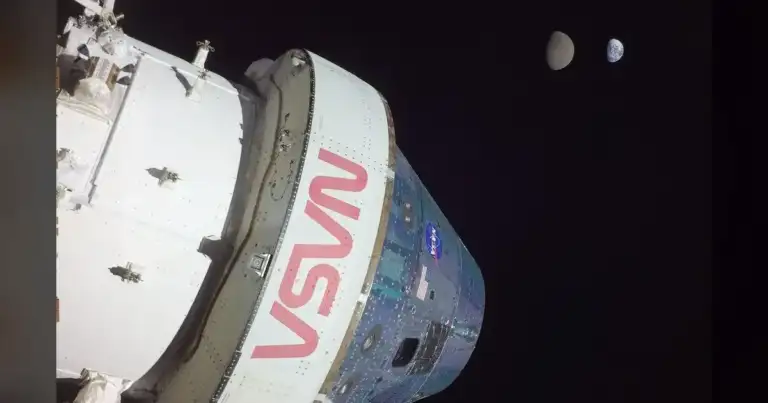

NASA’s latest “historic” Moon image isn’t just blurry; it’s an insult to anyone who remembers the crisp, awe-inspiring photographs from the Apollo era. This isn’t progress; it’s a pixelated punchline.
This whole Artemis II mission feels less like a bold step forward and more like a costly, uninspired rerun. Astronauts are indeed buzzing the Moon, but the most compelling news seems to be the repeated failure of the onboard toilet. This isn’t groundbreaking exploration; it’s a multi-billion-dollar space joyride disguised as a mission, and frankly, it’s making a mockery of American ambition.
Another Leaky Loo, Another PR Headache
The Artemis II crew just dropped their “landmark” image of the Moon. It was supposed to be iconic. Instead, the internet exploded with derision, with commentators rightly calling it “iPhone slop.” Here’s the kicker: Apollo 17, from a half-century ago in 1972, delivered images that were demonstrably sharper, more detailed, and frankly, more inspiring. How does an agency at the forefront of technological innovation manage to go backward in visual fidelity? It defies belief.
This visual disappointment is compounded by another embarrassing revelation: the crew once again had to fix the onboard toilet. Yes, you read that right—again. For a mission costing over $4 billion, you’d think NASA could engineer basic plumbing that actually works. This isn’t rocket science; it’s fundamental human waste management, a problem solved reliably on Earth for centuries. The fact that it’s a recurring issue on such a high-profile, high-cost mission speaks volumes about misplaced priorities or, worse, fundamental engineering oversight.
The mission itself is a mere ten-day fly-by. There’s no Moon landing, no new lunar feats, just a loop around our celestial neighbor. Given the exorbitant price tag, one has to ask: Is this truly worth the massive taxpayer investment, or are we simply paying for a glorified orbital selfie?
The “Historic Fly-By” or Just a Fly-Over?
NASA labels this mission “historic.” But let’s cut through the PR fluff: what exactly is historic about it? Orbiting the Moon has been done. The public, increasingly savvy and cynical, isn’t buying the hype. They see a repeat performance, not a giant leap for mankind. They see an agency struggling to justify its existence in an era of private space innovation.
The constant delays for Artemis I and now the toilet drama on Artemis II aren’t just minor hiccups; they’re eroding public trust. They make NASA look less like a pioneering scientific institution and more like a bureaucratic behemoth plagued by inefficiency. It certainly doesn’t inspire confidence in future, more complex missions, like a genuine return to the lunar surface or a journey to Mars. How can we trust them with interplanetary travel when they can’t even get a bathroom right?
Public reaction online is brutal, and rightly so. On platforms like Reddit’s r/space and X, the sentiment is overwhelmingly negative. People are frustrated, feeling like they’re being sold a bill of goods, a grand narrative that doesn’t align with the disappointing reality.
“Apollo 17’s 1972 shots are sharper than this iPhone slop from 2026? Tech regressed 50 years. What are we even paying for?” — Reddit User on r/space
This isn’t just about a blurry photo or a faulty toilet. It’s about trust, accountability, and NASA’s ability to deliver on its promises to the American people and the world. When the visuals are worse than those from half a century ago, and basic amenities fail, it’s not just a technical glitch; it’s a crisis of credibility.
The Financial Black Hole: Billions for a Bathroom Break
Let’s talk about the money, because that’s where the rubber meets the road. Artemis II is part of a larger program estimated to cost tens of billions. This specific fly-by alone is already costing over $4 billion. For that kind of cash, the expectation isn’t just competence; it’s perfection. It’s groundbreaking innovation, a return on investment that inspires awe and pushes the boundaries of human endeavor.
Instead, what do we get? Shoddy images and busted commodes. This isn’t just a “bad look” for an agency that relies entirely on public funding; it’s an outrage. It forces us to ask tough questions: Where is this staggering amount of money truly going? Is it genuinely funding science and exploration, or is it disappearing into the black hole of corporate contracts, bureaucratic bloat, and legacy program maintenance?
Companies like SpaceX and Blue Origin are receiving massive contracts, ostensibly to push the envelope. But are they truly delivering value commensurate with these astronomical sums? Or are we witnessing the same old pattern of cost overruns, underperformance, and a lack of accountability that has plagued large government projects for decades? The public deserves transparent answers, not just more PR spin.
China’s Lunar Gains vs. NASA’s PR Spin
While NASA struggles with basic amenities and delivers underwhelming visuals, other nations are making genuine, tangible strides in space. China, for instance, is actively pursuing its own ambitious lunar program. They are consistently landing rovers, collecting samples, and building a genuine, verifiable presence on the Moon. Their progress is quiet, methodical, and undeniably impressive, and it stands in stark contrast to NASA’s current performance.
Meanwhile, NASA seems stuck in a perpetual loop of self-congratulation for minimal achievements. The public increasingly views these “historic” missions as little more than a propaganda flex, an attempt to justify colossal budgets and keep legacy contractors like Boeing and Lockheed Martin flush with cash, rather than a genuine pursuit of scientific discovery or human expansion.
The comparison is stark, almost embarrassing. One nation is quietly and effectively building infrastructure and capabilities in space. The other is loudly celebrating a Moon fly-by and a fixed toilet. Which one is truly making history? Which one is actually inspiring the next generation of engineers and scientists? The answer is becoming painfully clear.
What Does This Mean for Careers and Innovation?
This growing cynicism isn’t just about public perception; it has profound implications for careers in the space industry and the future of innovation itself. If the public loses faith in NASA’s ability to deliver, funding will inevitably shrink. Top talent, seeing an agency mired in mediocrity and PR crises, might look elsewhere for more impactful and rewarding work. Innovation, the very lifeblood of space exploration, could stagnate.
NASA needs to get its act together, and fast. It needs to deliver tangible results, not just recycled imagery and hollow PR spin. It needs to demonstrate genuine, undeniable progress that justifies its existence and its enormous budget. The future of American leadership in space exploration, and the thousands of careers that depend on it, hangs in the balance.
We need missions that inspire awe and ambition, not missions that spark ridicule and frustration. We need real achievements, not just “historic” labels slapped onto underwhelming endeavors. The entire space industry, from government agencies to private ventures, needs to earn back public trust by delivering on its promises and pushing the boundaries of what’s truly possible.
The Bottom Line: Fix the Mission, Not Just the Toilet
This latest incident isn’t just about a broken toilet or a blurry photo; it’s about a broken promise. It’s about an agency that appears more focused on optics and self-preservation than on actual groundbreaking work. NASA needs to refocus its mission, recalibrate its priorities, and deliver real value for taxpayer dollars. The future of space exploration, and the careers built around it, depend on a fundamental shift from PR spectacle to genuine, inspiring accomplishment. It’s time to stop making excuses and start making history, the kind that truly moves us forward.
Source: Google News