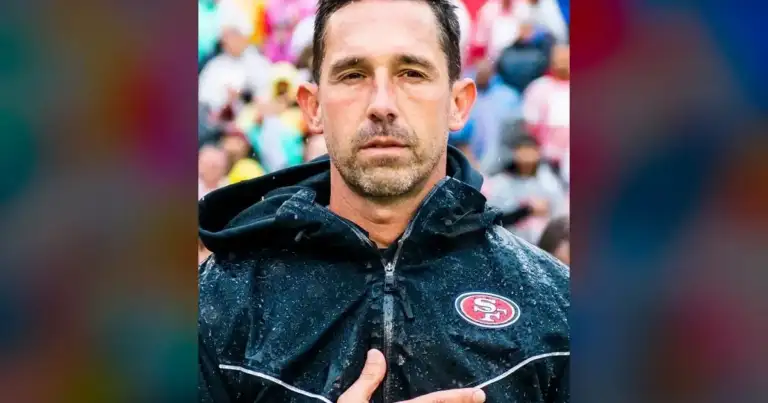

The NFL coaching carousel is a brutal grinder, a league of men who live and die by wins and losses, often sacrificing every ounce of their personal lives to the cause. So when a story drops about one of the league’s sharpest minds, San Francisco 49ers Head Coach Kyle Shanahan, revealing harrowing, previously untold details about a near-fatal accident from 2005, you have to ask: why now? Why, almost two decades later, is the full, gruesome extent of a life-altering injury suddenly on the table?
Shanahan, the architect behind some of the league’s most innovative offenses, is known for his stoic intensity and strategic brilliance. He lives and breathes football. We all knew he’d been in a serious car crash back in his early coaching days, a mere footnote in his rapid ascent.
But recent reports peel back a much darker layer. They paint a vivid picture of an incident far beyond a “bad crash.” This was a near-fatal eye injury, a moment that could have rendered him permanently sight-impaired, or worse, ended his career. The image of shattered glass and critical damage to his eye isn’t just a detail. It’s a gut punch, a stark reminder of how close the architect of the 49ers’ dynasty came to having his blueprint ripped up.
The Calculated Unveiling of Trauma
Let’s cut through the noise. It’s 2026. Kyle Shanahan is a household name in football, a perennial contender, and one of the highest-paid coaches. His public persona is one of relentless focus, sometimes bordering on icy detachment.
He’s not known for baring his soul on cue. This makes the timing of this deeply personal, almost cinematic revelation all the more intriguing. It’s not a casual aside. It’s a detailed account of a trauma that nearly robbed him of his vision and, by extension, his career.
In professional sports, every narrative is meticulously crafted. Nothing truly happens by accident. Is this an attempt to humanize the formidable figure who stalks the sidelines?
To add a layer of profound personal struggle to the already legendary “football savant” mythos? Perhaps. Modern sports fans, increasingly hungry for authenticity and “behind-the-curtain” stories, might see this as vulnerability from a man often perceived as impenetrable.
It’s a powerful narrative: the coach who overcame physical devastation to achieve greatness, a man whose very vision for the game was almost literally taken from him.
Beyond the Scar: Crafting a Legacy
This isn’t just about sharing a tough memory; it’s about shaping a perception. Coaches face constant scrutiny; every decision is debated on social media and dissected by talking heads.
A story like this provides a bedrock of resilience. It subtly suggests that a man who stared down blindness and rebuilt his life is perhaps uniquely equipped to handle the pressures of championship football.
It reinforces his intensity, not as mere stubbornness, but as the deep-seated drive of someone who understands how quickly everything can be lost. It’s a strategic play, whether consciously or subconsciously executed, to add another dimension to his public identity.
It’s a reminder that beneath the headset and the play-calling genius, there’s a man who has faced down the kind of adversity most of us can only imagine. And that, in the high-stakes chess match of NFL public relations, is a potent piece to move. It builds empathy, it builds respect, and it fortifies the image of a leader whose vision, both literal and metaphorical, has been hard-won.
“The image of shattered glass and critical damage to his eye isn’t just a detail; it’s a gut punch, a stark reminder of how close the architect of the 49ers’ dynasty came to having his blueprint ripped up before he even drew it.”
Red Marker Verdict:
Let’s be brutally honest: this isn’t just a coach reminiscing about a bad day. This revelation, surfacing almost two decades later, is a calculated enhancement of the Kyle Shanahan brand. It’s about solidifying his legend, adding a layer of near-mythic resilience to his already impressive resume.
In an industry where image is leverage, detailing a near-fatal eye injury isn’t vulnerability. It’s a powerful narrative tool designed to underscore his intensity, his focus, and his sheer will to overcome.
It tells the world: this man has faced worse than any defensive scheme, and he came back sharper. It’s about cementing his place as not just a great football mind, but a survivor whose very vision for the game was forged through personal catastrophe.
Photo: Alexander Jonesi 2019
Source: Google News