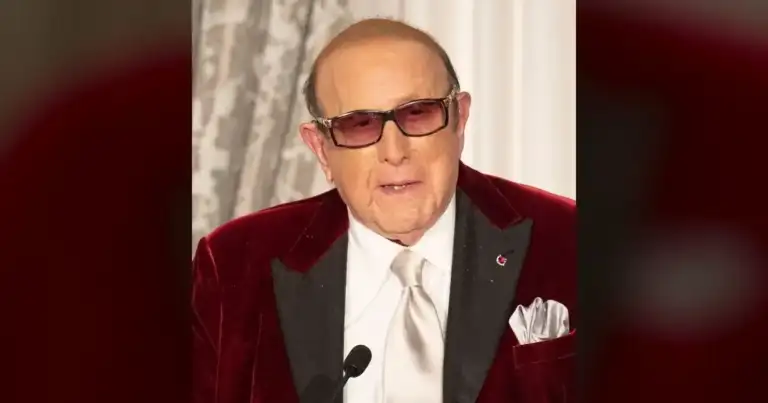

The music world isn’t just reeling; it’s collectively holding its breath, bidding a final, gut-wrenching farewell to the architect of modern sound, Clive Davis, who passed at the colossal age of 94. This isn’t merely the death of a mogul; it’s the silencing of a golden ear that shaped decades, leaving a chasm in an industry increasingly devoid of such singular vision.
His funeral wasn’t just a gathering; it was a summit of giants, a stark, emotional reckoning with the sheer, unquantifiable impact Davis had on countless careers.
The air hung thick with grief, yes, but also crackled with an almost defiant gratitude for his unwavering, almost stubborn, belief in pure artistry.
These weren’t just artists whose lives he touched; these were legends he forged. Their voices, thick with emotion, spoke volumes of his unparalleled vision and relentless, almost obsessive, dedication.
A Legacy Forged in Sound, Not Algorithms
Clive Davis didn’t just build an empire; he sculpted a dynasty, built not on fleeting trends or algorithms, but on raw, undeniable talent.
He didn’t just discover; he uncovered, nurturing icons from the ground up, often when the rest of the industry was chasing the next shiny object.
His journey, famously beginning at Columbia Records, then exploding with the founding of Arista Records and J Records, wasn’t just a career path; it was a seismic shift in how music was made and marketed.
He wasn’t a force; he was the force, a visionary and a mentor who didn’t just guide, but demanded greatness from generations of musicians.
His passing doesn’t just mark the end of an era; it’s a stark reminder of what we’ve lost – a true titan in a landscape increasingly populated by suits and spreadsheets.
The service wasn’t a parade of platitudes; it was a deeply personal, often raw, outpouring of gratitude, underscoring Davis’s almost alchemical ability to blend razor-sharp business acumen with an unyielding, almost spiritual, passion for music.
How many industry ‘experts’ missed the obvious?
Davis didn’t just see potential where others saw none; he mined it, polished it, and presented it to the world.
His commitment to artistic integrity wasn’t just legendary; it was a sacred vow in an industry notorious for compromise.
The Verdict from the Pantheon: Stars Share Their Truth
The tributes weren’t just heartfelt; they were raw, deeply moving confessions of gratitude, echoing through the hallowed halls. Alicia Keys, her voice a fragile whisper against the weight of her emotion, spoke not of influence, but of transformation.
“Clive didn’t just sign me; he saw me,” Keys shared, her voice thick with emotion. “He saw the artist, the woman, the potential, even when I was just a kid with a piano and a dream. He fought for my vision. Every note, every lyric, every success, a piece of it belongs to Clive.”
Keys recounted, with a candor that cut through the grief, how Davis didn’t just guide her through critical career moments; he forged her. He pushed her, relentlessly, to evolve, yet always demanded she stay brutally true to her authentic self. Her words didn’t just resonate; they echoed, a stark reminder of the mentorship that is now a vanishing art form.
Then came Barry Manilow, one of Davis’s earliest, and perhaps most unexpected, triumphs. His voice, usually so effortlessly smooth, cracked with emotion, his eyes welling up as he recounted a life forever changed.
“When I first met Clive, I was just a jingle writer,” Manilow reminisced. “He heard something in my songs, something I wasn’t even sure was there myself. He put me on a path I never dreamed possible. He’s not just a record man; he’s a visionary, a mentor, and a true friend.”
The raw emotion culminated in Manilow’s stripped-down, haunting rendition of “Mandy,” dedicated to the man who made it all possible. It wasn’t just a song; it was a eulogy in melody, a moment that brought even the most stoic, including Davis’s closest family, to their knees in tears.
The Maestro’s Touch: Resurrections and Rebirths
The spiritual pulse of the service quickened as rock icon Carlos Santana took the stage, delivering an address that was less speech, more sermon. He didn’t just credit Davis with a career resurgence; he spoke of a spiritual rebirth, a second coming orchestrated by the maestro himself.
“Clive is like a maestro conducting an orchestra of souls,” Santana declared. “He doesn’t just hear music; he feels the spirit in it. He helped me reconnect with that spirit, bringing ‘Supernatural’ to life. He reminds us all that music is a healing force, and he is one of its greatest conduits.”
Santana’s fervent testimony hammered home Davis’s almost mythical knack for not just reinventing careers, but resurrecting them from the ashes. He didn’t just bridge generational gaps; he obliterated them, weaving diverse sounds into a rich fabric that defied categorization. His intuition wasn’t just unmatched; it was a superpower in a business often blind to its own potential.
Echoes from the Empire: More Voices, Same Truth
Even those unable to attend sent their digital blessings, video tributes pouring in like a cascade of gratitude.
Sean “Diddy” Combs, the architect of Bad Boy Records, didn’t just credit Davis for a platform; he spoke of the bedrock, the foundation upon which his empire was built.
Jennifer Hudson, a symbol of resilience in her voice, recounted Davis’s steadfast, unyielding support through the kind of personal and professional challenges that would break lesser mortals.
The recurring theme wasn’t simple; it was a profound truth: Davis’s unparalleled ear for talent, his relentless, almost obsessive, pursuit of excellence, and a profound, often paternal, personal connection with his artists that transcended mere business deals.
These weren’t just legendary traits; they were the very fabric of his being.
Time and again, speaker after speaker hammered home the same, astonishing revelation: Davis’s belief in them, in their nascent, often fragile, talent, often dwarfed their own.
He didn’t just empower them; he ignited them, pushing them to scale heights they’d never even dared to dream.
He didn’t ask them to be better; he demanded it. He didn’t suggest greatness; he insisted upon it.
Clive Davis was never just a music executive.
He was a high priest of sound, a discoverer of raw, unvarnished dreams, a relentless builder of legends.
The industry won’t just feel his absence acutely; it will ache, a phantom limb reaching for the touch of a maestro no longer there.
His remarkable life and enduring impact won’t just echo; they will reverberate, a seismic tremor through every chord, every lyric, every beat for generations to come.
The question now isn’t whether true artistry will find a way – it’s whether an industry, increasingly beholden to data over discernment, can ever again produce a titan capable of truly listening like Clive Davis did. That, perhaps, is his most provocative, and haunting, legacy.
Photo: FREDDIE EVERETT
Source: Google News