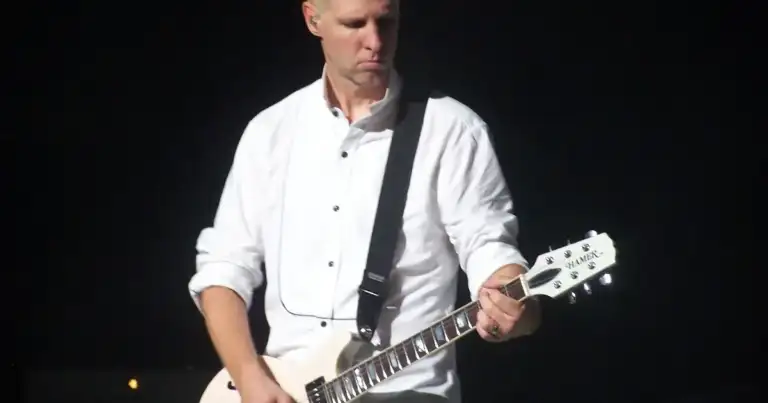

When No Doubt guitarist Tom Dumont revealed his Parkinson’s diagnosis last Friday, the outpouring of support was immediate – but so was a shocking, cynical online backlash that laid bare the worst of internet culture.
Dumont, 58, bravely shared his health battle on social media on April 11, 2026, later expanding on his journey in an exclusive interview with Variety on Saturday morning. He’d carried the weight of this diagnosis privately for approximately six months, demonstrating his quiet strength.
He recounted the terrifying onset of tremors, stiffness, and balance issues – symptoms that forced him to seek answers. Now, facing this formidable foe, Dumont declares he is committed to fighting the disease with every ounce of his being.
His No Doubt family rallied instantly. Gwen Stefani, always a fierce advocate for her bandmates, posted a heartfelt message on her own social media. She cut through the noise with pure, unadulterated support. “Tom is one of the most talented, kind, and resilient people I know,” she wrote. “We’re all here for him, every step of the way. Our brother, our guitarist, our friend.”
But almost before the ink was dry on Stefani’s post, the internet, in its predictable, venomous fashion, turned ugly. A chorus of online cynics didn’t just dismiss the news; they weaponized it, branding Dumont’s devastating diagnosis a calculated PR stunt designed purely to hype No Doubt’s upcoming 18-show Las Vegas Sphere residency.
On Reddit, threads across r/popheads and r/NoDoubt exploded with a sickening wave of sarcasm. “Convenient timing,” one user sneered, as if a life-altering illness could be scheduled. “Symptoms for ‘years’ but drops this bomb right before Vegas tickets drop? Classic celeb sob story for streams.”
Over on X (formerly Twitter), the hashtag #TomDumontFake began trending – a stark reminder of humanity’s capacity for cruelty. Music gossip accounts, ever eager for a cheap shot, were brutal. “Parkinson’s at 58? Or just bad acting?” one tweet sniped, as if disease were a performance. Another added, “No Doubt hasn’t toured since 2018—sudden health reveal screams desperation.”
And then there was 4chan’s /mu/ board, a cesspool of baseless conspiracy theories, where users ludicrously claimed it was a “sympathy ploy” amid No Doubt’s “perceived irrelevance.” Even TikTok, usually a haven for fleeting trends, became a platform for dismissive eye-rolls at Dumont’s genuinely upbeat, defiant message.
The Harsh Reality of a Parkinson’s Diagnosis
This public cruelty, this digital mob mentality, doesn’t just ignore a devastating truth; it actively spits on it. Parkinson’s disease is not a marketing tool; it is a serious, progressive neurological condition that relentlessly affects nearly one million people in the U.S. annually.
With approximately 90,000 new cases diagnosed each year, the numbers alone are sobering. For a musician, especially a guitarist, Parkinson’s symptoms like tremors, rigidity, and slowness of movement directly assault their craft. These aren’t just inconveniences; they threaten a musician’s identity and livelihood.
The disease’s relentless progression often forces artists to make heartbreaking choices. Many must adapt their playing styles beyond recognition, or even stop performing entirely. This is not a celebrity narrative to be mocked; it is a life-altering diagnosis demanding understanding, not scorn.
Beyond the personal devastation, the estimated financial burden of Parkinson’s is staggering, costing nearly $52 billion per year in the U.S. This isn’t just a line item in a budget; it’s a crushing weight of medical bills, lost wages, and caregiving expenses that falls disproportionately on families and strains our healthcare system.
In stark contrast to the online vitriol, Dr. Eleanor Vance, a leading neurologist and Parkinson’s specialist, lauded Dumont’s immense bravery, calling his decision to speak out “incredibly brave and valuable.”
“Mr. Dumont’s decision to speak out is incredibly brave and valuable. Public figures sharing their diagnoses helps demystify Parkinson’s, encourages early detection, and fosters a more supportive environment for patients. Early intervention is key to managing symptoms and maintaining quality of life.”
Dr. Vance’s words are a crucial reminder: early intervention isn’t just beneficial; it is vital for managing symptoms and preserving a good quality of life for patients. This is irrefutable medical science, not a flimsy celebrity narrative to be cynically dissected and mocked.
Artists Fighting for Their Craft
Dumont, tragically, is not the first prominent musician to face this brutal battle. The legendary Johnny Cash, for instance, continued to perform and record with defiant grit, even after his diagnosis with Shy-Drager syndrome, a form of Parkinsonism that slowly stole his physical capabilities.
And who could forget the heartbreaking silence of folk icon Linda Ronstadt, forced to retire from singing due to progressive supranuclear palsy, a condition that cruelly ravaged her vocal cords? Her story powerfully illustrates the profound, often career-ending, impact neurological conditions can have on an artist’s gift.
These artists’ journeys are not just tales of immense resilience; they are raw, powerful examples of the difficult, often agonizing, choices artists are forced to make when their physical health directly threatens their ability to create and share the art that defines them.
Against this backdrop of online vitriol and the crushing weight of his diagnosis, Dumont himself remains defiantly, inspiringly strong. “It’s a strange feeling,” he told Variety. “To have your body start to betray you in ways you never expected. But I’m not giving up.”
“It’s a strange feeling, to have your body start to betray you in ways you never expected. But I’m not giving up. Music is my life, and I’m determined to find new ways to express myself, even if it means learning to play differently. This isn’t the end; it’s just a new chapter.”
His commitment to finding new ways to express himself through music – the very essence of his being – is not merely a plan; it’s a profound declaration of war against a disease that seeks to silence him. This unwavering spirit, this refusal to be defined by illness, is the true, indomitable heart of an artist.
Beyond the Cynicism: Choose Empathy and Awareness
So, we must ask: In a world supposedly more connected than ever, why do some rush to such callous, baseless judgment? Why does public empathy, a foundational human trait, evaporate the moment a keyboard is touched? We are witnessing a human being, a beloved artist, facing a terrifying, unpredictable illness, fighting not just for his health, but for his very passion.
His courage, his raw vulnerability, should not invite ridicule or cruel speculation; it should inspire us all. Let us be unequivocal: public figures are not mere avatars for our entertainment or targets for our projections. They are human beings, deserving of the same compassion, the same grace, as anyone else facing profound pain and fear.
This story, stripped of the online noise, serves as a potent mirror, reflecting our own vulnerabilities back at us. It underscores the critical importance of early diagnosis for any health issue and, perhaps most profoundly, the absolute necessity of supporting our loved ones through their toughest, most frightening times.
Far from a cynical ploy, Dumont’s courageous choice to speak publicly is raising crucial awareness about Parkinson’s. It actively works to reduce the insidious stigma often associated with chronic illness. This strengthens the Parkinson’s community worldwide. This is not just an act of vulnerability; it is a profound, selfless act of advocacy.
So, what will we choose? To wallow in the cheap, performative cynicism that poisons our digital spaces? Or to rise above it, to embrace human strength, resilience, and the profound courage it takes to share one’s truth? Let us not just support artists like Tom Dumont, but defend them. For in their art, in their battles, and in their unwavering spirit, lies a richer, more empathetic reflection of humanity that truly enriches us all.
Source: Google News