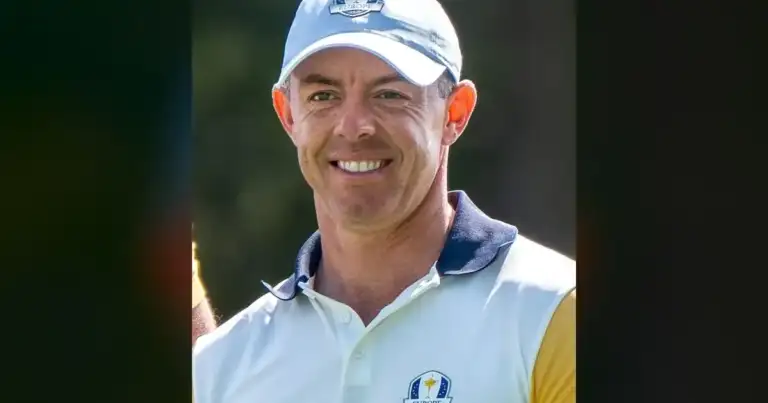

Let’s be unequivocally clear: the media’s breathless pronouncements of a “secret crisis” surrounding Rory McIlroy’s second consecutive Masters triumph were nothing short of a journalistic farce. There was no inner turmoil, no seismic family rift; merely a champion athlete and a dash of playful superstition. A ravenous press corps desperate to invent drama where none existed drove the false narrative. McIlroy didn’t just win on April 12, 2026; he dominated Augusta National. He finished a commanding 14-under-par to secure the Green Jacket by three strokes, showcasing pure, unadulterated skill.
His parents, Gerry and Rosie McIlroy, were indeed present at Augusta National, a notable change from his inaugural Masters victory the previous year. But to spin this simple family reunion into a psychological battle? That’s not reporting; that’s cheap theatrics.
The Manufactured Narrative: A Crisis of Imagination
The so-called “mainstream media” didn’t just want you to believe Rory McIlroy was wrestling with some profound personal struggle; they actively fabricated it. They didn’t just peddle a story of “off-course drama” and “inner turmoil”; they force-fed it, a grotesque distortion of reality designed to harvest clicks, not to illuminate truth. This wasn’t journalism; it was a cynical exercise in narrative engineering.
The actual “drama,” if one could even dignify it with such a term, was laughably simple. McIlroy, like countless athletes, entertained a fleeting, mild superstition. His parents, Gerry and Rosie, missed his first Masters win, and he mused aloud if their absence had somehow contributed to his success.
Is this the stuff of Greek tragedy? Of course not. It’s the kind of relatable, human quirk that makes champions accessible, not a sign of deep-seated neurosis.
This isn’t a “secret crisis”; it’s a common psychological tic. Every elite performer has their rituals, their lucky socks, their pre-game routines. McIlroy simply decided he wanted his parents present for his second, historic victory.
And they were. They witnessed history. Where is the conflict in that?
The media machine, however, cannot function without friction. It craves a narrative, any narrative, no matter how flimsy. A son’s playful superstition is thus transmuted into a Shakespearean family saga, cheapening not only the athlete’s genuine achievement but the very concept of human emotion itself.
“I was half-joking about them not being here last year,” McIlroy reportedly said, dismissing the frenzy with the ease of a master golfer. “But seeing them in the crowd, it just felt right. No real drama, just a bit of fun.”
This brand of sensationalism isn’t just rampant; it’s corrosive. It actively distracts from the true story – the grit, the grind, the sheer talent. It ignores the monumental effort and surgical skill required to dominate at the highest level.
This is a disservice to the sport and to anyone seeking genuine insight.
True Quality on the Green: The Undeniable Performance
Forget the insipid, made-up family drama. The real story, the only story worth telling, is McIlroy’s utterly dominant performance. He didn’t just conquer Augusta National for the second year running; he established a new benchmark for mastery.
His swing, a marvel of kinetic energy and fluid motion, is not merely a “finely tuned engine”; it’s a precision instrument. Every single shot, from the tee box to the green, demanded perfect calibration. Consider his final round 68, a masterclass under immense pressure, featuring five crucial birdies and only one bogey.
His driving accuracy for the tournament hovered around 75%, consistently putting him in prime position. His average of 1.6 putts per green in regulation speaks to an ice-cold nerve on Augusta’s treacherous surfaces. This is where true quality asserts itself, not in the ephemeral noise of manufactured headlines.
Instead of dissecting non-existent “crises,” we should be reverently discussing his iron play – how he consistently attacked flags with audacious confidence. We should be analyzing his putting under the most suffocating pressure, the subtle reads and the unwavering stroke that defines a champion. We should be dissecting the mental fortitude required to not just win one Green Jacket, but to defend it with such authority.
These are the “goods” that define greatness; everything else is mere distraction.
His approach on the iconic 13th hole in the final round wasn’t just surgical; it was a statement. His putt on the 18th, sinking to secure his legendary status, was the exclamation point on a performance for the ages. These moments, etched into the hallowed grounds of Augusta, are the true heritage of the sport.
They are what discerning men respect, what true fans demand.
The incessant chatter of a “lucky charm” is not just fluff; it’s an insult to his craft. McIlroy’s talent is his only true charm, honed through countless hours of rigorous practice. His hard work is not merely undeniable; it’s the bedrock of his success.
He didn’t need a superstition to win; he needed his unparalleled skill, his unshakeable nerve, and his absolute refusal to be anything but the best.
The media, in its insatiable hunger for a tear-jerking narrative, seeks to invent struggle where none exists. This doesn’t just dilute the power of genuine sporting triumph; it cheapens the very essence of human achievement. It’s a disservice to the athlete, the sport, and the intelligent audience who deserves better.
Beyond the Hype: Demand Substance, Not Spectacle
Why, then, do we continue to tolerate this utterly cheap narrative? It isn’t merely lazy journalism; it’s an intellectual insult. It reveals precisely nothing about the intricate ballet of the sport, nor does it offer any genuine insight into the athlete’s relentless craft.
It’s a void masquerading as content.
Source: Google News