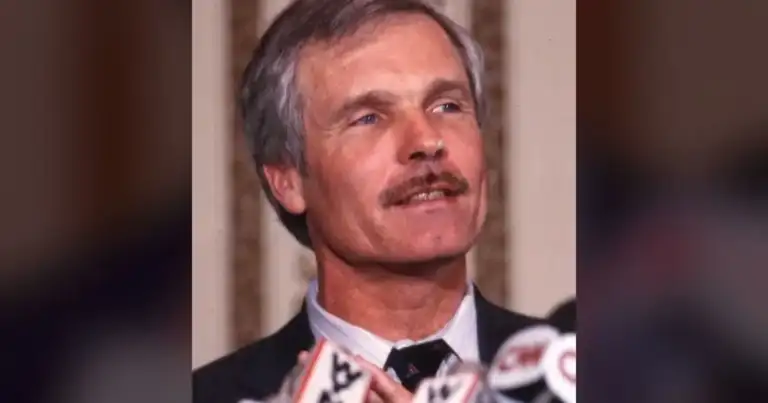

The old pirate, Ted Turner, finally sailed into the sunset at 87, but the storm he brewed – 24/7 news – still rages, and his true, often chaotic, legacy was etched into the global consciousness decades ago.
The titan of media, the audacious environmentalist, the visionary philanthropist, breathed his last at his Florida sanctuary on May 5, 2026. Surrounded by family, the curtain fell on a life lived loudly, even as his final years were marked by the quiet, cruel advance of Lewy body dementia, a diagnosis he wrestled with publicly since 2018. His passing wasn’t a sudden jolt, but the inevitable fade of a man whose mind, once a whirlwind, had been slowly, tragically dimmed.
Turner’s departure isn’t just the end of an era; it’s the closing chapter on a seismic shift he initiated. When he launched the Cable News Network (CNN) in 1980, he didn’t just create a channel; he detonated a bomb under traditional journalism, forever altering the very fabric of how humanity receives its daily dose of reality, or manufactured reality, depending on your perspective.
The Maverick Who Wired the World
Turner wasn’t just a pioneer; he was an unruly force of nature in a suit. He inherited a billboard business and, with a gambler’s instinct and a visionary’s foresight, transmuted it into a broadcasting behemoth. He didn’t just launch WTBS; he hurled one of the first “superstations” into the ether, beaming content via satellite directly into American living rooms, a precursor to the always-on world we now inhabit.
But the real game-changer, the veritable thunderclap, was CNN. Initially derided as “Chicken Noodle News” by the old guard, it became the undisputed global authority during the 1991 Gulf War. While traditional networks scrambled to edit soundbites, CNN was there, live, raw, and unfiltered, broadcasting from Baghdad as bombs fell.
It wasn’t just coverage; it was a front-row seat to history. This cemented CNN’s status and, in doing so, dragged every other news outlet, kicking and screaming, into the 24/7 news cycle Turner had envisioned.
His restless vision, however, couldn’t be contained by news alone. He bought the Atlanta Braves baseball team and the Atlanta Hawks basketball team, injecting his boisterous, often controversial, personality directly into professional sports. He was the owner who’d sit in the dugout, who’d challenge his players, who’d connect with fans in a way few others dared.
He delivered: the Braves, under his audacious leadership, finally snatched a World Series championship in 1995. This proved his Midas touch wasn’t just for media.
Turner was, in every sense, the “Mouth of the South” – a moniker he wore like a badge of honor. He didn’t just speak his mind; he bellowed it, often with a mischievous grin and always with unapologetic conviction.
“I’m not afraid to fail. I’m not afraid to succeed. I’m not afraid to be myself.” – Ted Turner.
Such unvarnished candor, in an age of carefully curated public personas and corporate-speak, feels almost alien. He was a walking contradiction: brilliant, bombastic, generous, infuriating. A figure who courted controversy as readily as he embraced innovation.
Yet, even his fiercest critics had to concede: his vision, however outlandish it sometimes seemed, was often prescient, rarely misguided, and almost always transformative.
The Billion-Dollar Handshake
But Turner’s ambition extended far beyond flashing screens and sports arenas. He harbored a profound, almost primal, connection to the earth, transforming himself into one of the largest private landowners in the United States. This wasn’t some vanity project; he dedicated millions of acres to conservation, rewilding vast swathes of land.
This commitment underscored his belief that true wealth lay not in what you owned, but in what you protected. This wasn’t just talk; it was action on a scale that shamed most corporate environmental initiatives.
Then, in 1997, he dropped a philanthropic bombshell that echoed across the globe: an unprecedented pledge of $1 billion to the United Nations. This wasn’t a donation; it was a defiant statement, a challenge to other billionaires, and the genesis of the UN Foundation in 1998. It remains an unparalleled benchmark for global philanthropy, a stark reminder of what true, audacious commitment to global cooperation and environmental stewardship looks like in an era often defined by self-interest.
And then there was Jane. His high-profile marriage to actress Jane Fonda, from 1991 to 2001, wasn’t just a celebrity pairing; it was a cultural phenomenon. It was a union of two fiercely outspoken, often polarizing, figures who, together, wielded immense influence.
They were a power couple in the truest sense. Their dynamic, if sometimes tumultuous, duo saw every move scrutinized, admired, and occasionally condemned.
“He changed the world of news. He changed the world of sports. He changed the world of philanthropy. He was one of a kind.” – Unnamed CNN executive, May 5, 2026.
The Empire After the Emperor
So, what becomes of the vast media empire and the philanthropic behemoths he forged, now that the emperor is no more? The blunt reality is, his direct operational hand on the media tiller vanished decades ago.
He sold his crown jewel to Time Warner in 1996 – a generation past. The empire, in its original form, has long since outgrown its architect.
The enduring genius of Turner wasn’t just in building; it was in building to last. The institutions he birthed – particularly the UN Foundation, which blossomed from his audacious $1 billion pledge, now facilitating billions more for global causes – operate with robust independence. His 2 million acres of cherished land aren’t left to chance; they’re meticulously managed by conservation trusts, ensuring his environmental legacy endures, wild and untamed.
His death, then, isn’t a collapse; it’s merely a definitive bookmark in the epic saga of a life. It is not a disruption to the powerful currents he set in motion.
The public reaction, predictably, has been less a gasp and more a quiet nod. There’s a wistful nostalgia for the freewheeling days of the TBS superstation, and a respectful acknowledgment of the CNN revolution.
But the shock, the raw jolt of a titan falling, was absorbed years ago. His long, public battle with Lewy body dementia meant his passing was not a surprise, but the solemn, anticipated conclusion to a life that had already begun to recede from the daily headlines.
Ted Turner was more than a man; he was a phenomenon, a whirlwind of brilliance, ego, and audacious vision. He didn’t just leave an indelible mark on media, sports, and philanthropy; he fundamentally rewrote the rules for all three. His innovations don’t just ‘shape’ our daily lives; they are the very bedrock upon which
Photo: Library of Congress: P&P
Source: Google News